
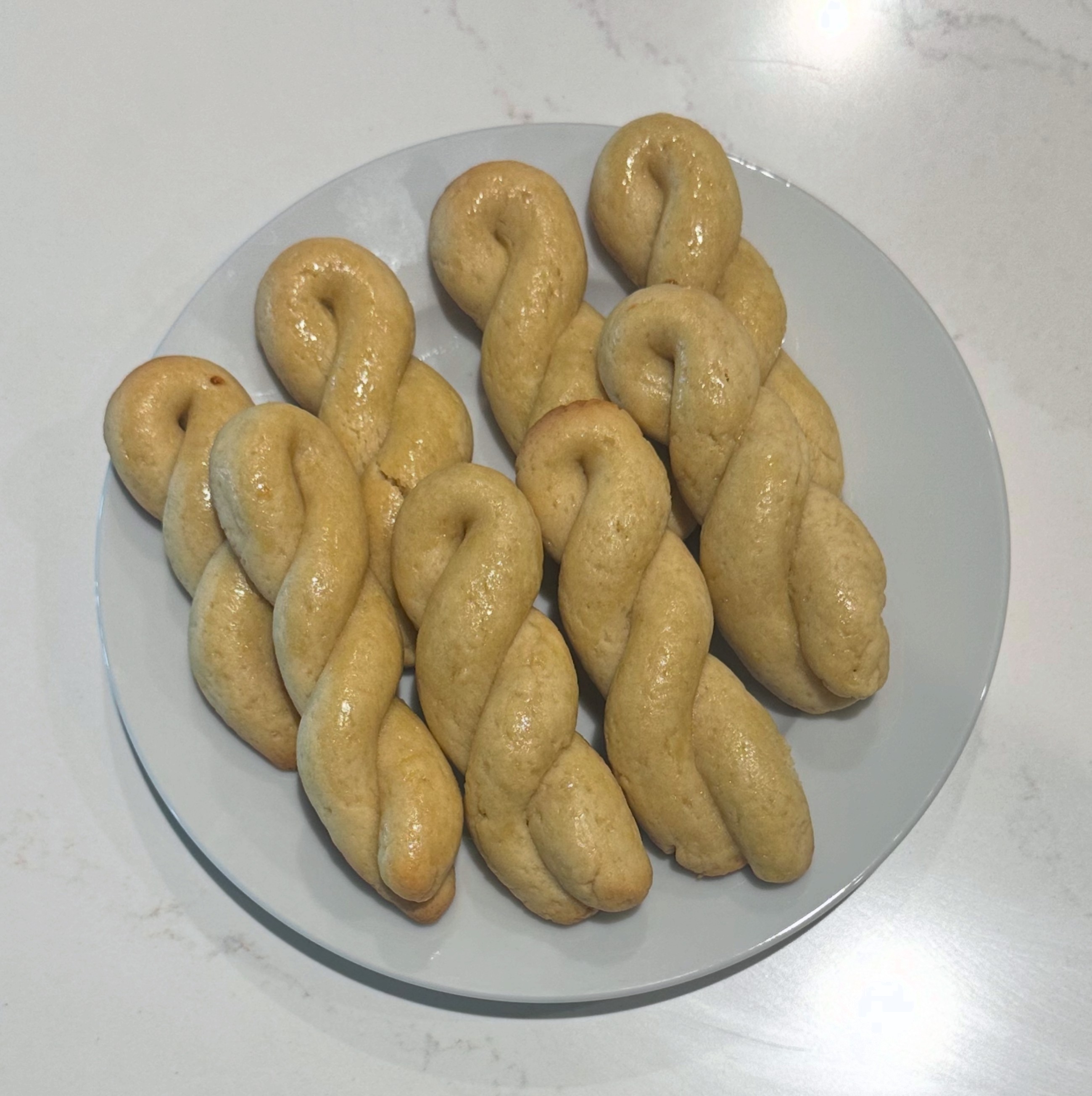
These golden, buttery cookies are traditionally baked in Greece to celebrate Easter, but honestly… once you taste them, you’ll wonder why they’re saved for only once a year. With their soft, orange-kissed dough, shiny egg-washed tops, and just the right touch of vanilla, they’re a true holiday staple.
But here’s where I added my own little twist: after baking, I gave them a light brush of orange simple syrup. It’s a subtle addition, but it adds a gorgeous sheen and teases out even more of that bright citrus flavor hiding in the dough. The result? A cookie that feels both traditional and just a little extra special.
Ingredients
- 1 cup unsalted butter, melted and then cooled
- 1 1/4 cup sugar
- 3 large eggs (reserve one for egg wash and bring to room temperature)
- 1 tsp vanilla extract
- 1 orange
- 4 1/4 cups all-purpose flour
- 1 tsp baking powder
- 1 tsp baking powder
- 1 tbsp of milk (any kind will do)
Instructions
- Preheat oven to 350°F (175°C) and line a baking sheet with parchment paper.
- In a large bowl, cream butter and sugar until light and fluffy.
- Beat in 2 eggs, vanilla, and citrus zest.
- Whisk baking powder into flour, then gradually add to wet mixture, kneading gently to form soft dough.
- Divide dough into small portions, roll into ropes about 6 inches long, and braid or twist into rings or figure-eights.
- Place on baking sheet, brush with beaten reserved egg for a shiny glaze.
- Bake 20–25 minutes until golden and fragrant. Cool on a wire rack.
Cultural Notes
Koulourakia are closely associated with Greek Easter traditions, symbolizing renewal and celebration. Their ring shapes are said to represent unity and eternity. Families often bake them together, making the process a cherished ritual.
A Personal Twist on Tradition
Instead of leaving the cookies with just their golden egg wash, I gave them a little extra love. I had some leftover orange simple syrup on hand and thought, why not? Once the koulourakia came out of the oven, I grabbed a clean pastry brush and gave each cookie the lightest coat.
When they cooled, the cookies had a subtle sheen and (to my delight) the syrup gently highlighted the orange zest already in the dough. A tiny tweak, but it added such a bright, fragrant note. 🍊✨
Serve your koulourakia alongside a strong Greek coffee or a cup of tea for the coziest afternoon break.

Koulourakia — Greek Easter Cookies You’ll Want Year-Round
Course: Greek RecipesCuisine: DessertDifficulty: Easy30
servings30
minutes20
minutes160
kcal30
minutesIngredients
1 cup of butter (melted and cooled)
1 cup of sugar
2 eggs (room temperature)
1 orange (zest & juice)
1 tsp of vanilla
1 tsp of baking powder
1 tsp of baking soda
4 1/4 cups of flour
- Egg Wash
1 tbsp of milk
1 egg yolk
- Simple Syrup (optional)
1/2 cup of sugar
1/2 cup of water
1 orange peel
Directions
- Preheat the oven to 350°F (175°C). Line a baking sheet with parchment paper.
- Cream the butter and sugar together in a large bowl until pale, fluffy, and smooth — it should look a bit like thick whipped cream.
- Zest and juice the orange. Place the zest and juice in a small bowl.
If making the optional orange simple syrup: remove one strip of orange peel before zesting and juicing, and set it aside. - Optional syrup: In a small saucepan, bring ½ cup water, ½ cup sugar, and the reserved orange peel to a boil. Stir until the sugar dissolves, then remove from heat and let it cool completely.
- Add the eggs to the creamed butter one at a time, mixing well after each addition. (If the mixture looks a little lumpy because of cold eggs, don’t worry — it will smooth out later.)
- Mix the wet flavorings. In a separate bowl, combine the orange juice, zest, vanilla extract, baking powder, and baking soda. Stir until well blended.
- Combine the mixtures. Add the orange juice mixture to the butter-egg mixture and mix until fully incorporated.
- Add the flour gradually. With the mixer on low speed (paddle attachment if using a stand mixer), add ½ to 1 cup of flour at a time until the dough comes together. The dough should be soft and pliable, not sticky. If it feels sticky, add a little more flour slowly — but don’t overdo it or the cookies may turn out dry.
- Chill the dough. Cover the bowl and refrigerate for 30 minutes to rest.
- Shape the cookies. Scoop out dough portions (about 30 g each, or golf-ball sized if eyeballing). Roll each portion into a rope about 7 inches long, then twist or braid into your desired shape.
- Prepare the egg wash. Whisk together 1 egg and a splash of milk in a small bowl. Brush lightly over the shaped cookies.
- Bake. Place cookies on the prepared sheet, leaving a little space between each. Bake for 18–22 minutes, or until golden brown.
- Optional syrup glaze: Once baked, lightly brush the cooled cookies with the orange simple syrup for an extra sheen and a subtle citrus boost.
- Cool & enjoy. Let cookies cool fully before serving. They pair beautifully with Greek coffee or hot tea.
Next week, we’ll bring a burst of citrus sunshine with Portokalopita, a luscious orange phyllo pie that’s like a Greek summer in every bite.